Score |
66


Galton
 Student @ University of Lagos
Student @ University of Lagos



The Moral Compass of AI: What Should Technology Be Allowed to Do in Nigeria?
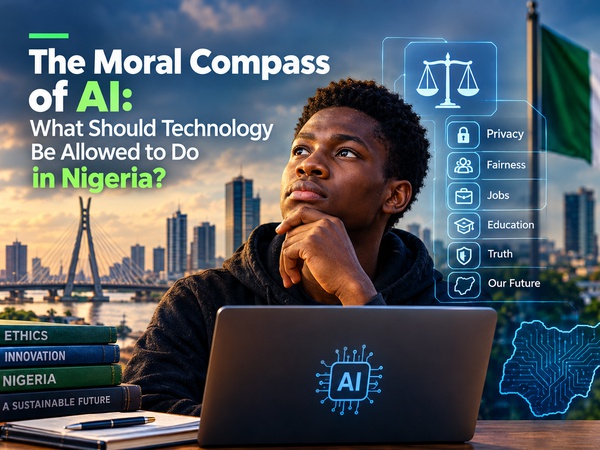
<p>Artificial intelligence is becoming increasingly capable.</p><p><br/></p><p>It can write, create images and videos, analyse enormous quantities of information, assist with medical research, generate software and perform tasks that once required human judgment.</p><p><br/></p><p>But there is a question that technical progress alone cannot answer:</p><p><br/></p><p>Just because AI can do something, does that mean it should?</p><p><br/></p><p>For Nigeria, this is not a distant philosophical question.</p><p><br/></p><p>It is already becoming a practical one.</p><p><br/></p><p>AI will increasingly influence how Nigerians learn, work, access financial services, consume information, interact with businesses and potentially interact with government.</p><p><br/></p><p>The choices Nigeria makes now could determine whether artificial intelligence becomes a tool for broader opportunity or another technology that deepens existing inequalities.</p><p><br/></p><p>Nigeria cannot afford to treat AI ethics as a foreign debate</p><p><br/></p><p>Much of the global conversation about responsible AI comes from Silicon Valley, Europe and other major technology centres.</p><p><br/></p><p>Nigeria needs to participate in that conversation—but it also needs to ask its own questions.</p><p><br/></p><p>What does responsible AI mean in a country with hundreds of languages?</p><p><br/></p><p>What happens when an AI system understands American or European contexts better than Nigerian ones?</p><p><br/></p><p>What happens when an algorithm makes assumptions about Nigerians using datasets that do not adequately represent Nigerian realities?</p><p><br/></p><p>And what happens to people who are not digitally sophisticated enough to know when an AI system has made a mistake?</p><p><br/></p><p>These are not abstract concerns.</p><p><br/></p><p>Nigeria's digital economy is expanding rapidly, and artificial intelligence will increasingly become part of that ecosystem.</p><p><br/></p><p>The country therefore needs more than access to AI technology.</p><p><br/></p><p>It needs the capacity to question, regulate, audit and responsibly deploy it.</p><p><br/></p><p>The Nigerian data problem</p><p><br/></p><p>Data is the fuel of modern AI.</p><p><br/></p><p>Nigeria is producing enormous quantities of digital information through banking, telecommunications, social media, e-commerce, education and government services.</p><p><br/></p><p>That creates opportunity.</p><p><br/></p><p>It also creates responsibility.</p><p><br/></p><p>Nigeria's Nigeria Data Protection Act 2023 established a national framework for protecting personal data and created the Nigeria Data Protection Commission. The law reflects a fundamental principle: technological innovation should not eliminate an individual's right to control how personal information is handled.</p><p><br/></p><p>But AI introduces new complications.</p><p><br/></p><p>A person may willingly provide information for one purpose without understanding that the information could later be analysed by an AI system for another purpose.</p><p><br/></p><p>That raises a basic question:</p><p><br/></p><p>Does giving data to a system mean giving that system unlimited permission to understand us?</p><p><br/></p><p>The answer should not be assumed to be yes.</p><p><br/></p><p>Privacy is not merely about hiding information.</p><p><br/></p><p>It is about maintaining a degree of control over our identities and lives.</p><p><br/></p><p>Fintech: when an algorithm decides who gets a chance</p><p><br/></p><p>Nigeria has become one of Africa's most important fintech markets.</p><p><br/></p><p>Millions of Nigerians interact with digital financial services, and automated systems can help institutions assess transactions, detect fraud and make lending decisions.</p><p><br/></p><p>The potential benefits are substantial.</p><p><br/></p><p>But automated financial decisions can also create serious consequences.</p><p><br/></p><p>Imagine an AI system assessing whether someone deserves a loan.</p><p><br/></p><p>If the underlying data reflects historical inequalities, informal employment patterns or gaps in someone's financial history, an apparently objective system could disadvantage people who are already underserved.</p><p><br/></p><p>The computer may not intend to discriminate.</p><p><br/></p><p>But intention is not the only issue.</p><p><br/></p><p>The outcome matters.</p><p><br/></p><p>If an individual is denied access to credit, housing, employment or another important opportunity because of an automated decision, that person should have a meaningful way to understand and challenge the decision.</p><p><br/></p><p>Efficiency should never become an excuse for removing accountability.</p><p><br/></p><p>AI and Nigeria's education crisis</p><p><br/></p><p>Education may be one of the areas where AI has extraordinary potential in Nigeria.</p><p><br/></p><p>A student with an internet connection can potentially access explanations, tutoring, language assistance and educational materials that would previously have been difficult to obtain.</p><p><br/></p><p>For students who cannot afford private tutoring, this could be transformative.</p><p><br/></p><p>But there is another side.</p><p><br/></p><p>AI can also make academic dishonesty easier.</p><p><br/></p><p>Students can generate essays, solve assignments and produce apparently sophisticated work without necessarily understanding the material.</p><p><br/></p><p>The ethical challenge is therefore not simply whether students use AI.</p><p><br/></p><p>It is whether Nigerian education systems can adapt their definition of learning.</p><p><br/></p><p>If memorising information becomes less important because machines can retrieve it instantly, schools and universities may need to place greater emphasis on reasoning, originality, critical thinking, practical skills and the ability to verify information.</p><p><br/></p><p>The goal should not be to teach young Nigerians how to compete against machines.</p><p><br/></p><p>It should be to teach them how to work intelligently with machines without surrendering their own judgment.</p><p><br/></p><p>The language problem</p><p><br/></p><p>There is another issue particularly important to Nigeria: language.</p><p><br/></p><p>English dominates much of the digital and AI ecosystem.</p><p><br/></p><p>But Nigeria is not an English-only society.</p><p><br/></p><p>Yorùbá, Igbo, Hausa, Fulfulde, Kanuri, Tiv, Ibibio and hundreds of other Nigerian languages are part of the country's cultural identity.</p><p><br/></p><p>If AI systems are significantly better at understanding some languages than others, technological inequality can become linguistic inequality.</p><p><br/></p><p>A person should not receive a dramatically worse digital service simply because their language has less representation in training data.</p><p><br/></p><p>This is why Nigerian participation in AI development matters.</p><p><br/></p><p>Nigeria should not merely be a market where foreign AI products are consumed.</p><p><br/></p><p>Nigerian researchers, engineers, linguists, universities, entrepreneurs and policymakers should help shape the datasets, models, applications and rules that determine how AI understands Nigeria.</p><p><br/></p><p>Deepfakes and the Nigerian information environment</p><p><br/></p><p>Nigeria already has a highly active social-media culture.</p><p><br/></p><p>Information can travel across WhatsApp, Facebook, X, TikTok and other platforms at extraordinary speed.</p><p><br/></p><p>Generative AI makes the situation more complicated.</p><p><br/></p><p>A fabricated photograph can look authentic.</p><p><br/></p><p>A person's voice can potentially be imitated.</p><p><br/></p><p>A video can be manipulated.</p><p><br/></p><p>A false statement can be presented with convincing visual evidence.</p><p><br/></p><p>This has consequences beyond entertainment.</p><p><br/></p><p>During elections, political disputes, communal tensions or major national events, convincing false content can influence how people perceive reality.</p><p><br/></p><p>The challenge is not simply to tell Nigerians:</p><p><br/></p><p>“Don't believe everything you see online.”</p><p><br/></p><p>That advice is no longer sufficient.</p><p><br/></p><p>We need better digital literacy, stronger verification practices, responsible journalism and systems that make manipulated content easier to identify.</p><p><br/></p><p>Most importantly, Nigerians need to preserve the habit of asking:</p><p><br/></p><p>Where did this information come from?</p><p><br/></p><p>AI and the Nigerian workplace</p><p><br/></p><p>Nigeria has a young and ambitious population.</p><p><br/></p><p>AI could create new opportunities in software development, creative industries, research, customer service, education and entrepreneurship.</p><p><br/></p><p>But it could also automate some forms of work.</p><p><br/></p><p>That makes the Nigerian conversation different from the conversation in wealthy economies where workers may have greater access to retraining and social protection.</p><p><br/></p><p>For many Nigerians, employment is already closely connected to economic survival.</p><p><br/></p><p>If automation changes an industry, telling displaced workers to “learn AI” is not, by itself, a sufficient solution.</p><p><br/></p><p>Who pays for retraining?</p><p><br/></p><p>Who provides access to the necessary devices and internet?</p><p><br/></p><p>What happens to people who cannot transition quickly enough?</p><p><br/></p><p>What happens to workers outside major cities?</p><p><br/></p><p>Technological progress should therefore be measured not only by how much productivity it creates, but also by who gets the opportunity to participate in that progress.</p><p><br/></p><p>The digital divide could become an AI divide</p><p><br/></p><p>Nigeria's AI future will not be experienced equally.</p><p><br/></p><p>A professional in Lagos with a reliable internet connection, modern computer and access to sophisticated AI tools lives in a very different technological reality from a student in a rural community struggling with electricity and internet access.</p><p><br/></p><p>This creates a danger.</p><p><br/></p><p>The digital divide could become an AI divide.</p><p><br/></p><p>Those with access to powerful tools could become dramatically more productive, while those without access fall further behind.</p><p><br/></p><p>That is why discussions about AI in Nigeria cannot be separated from infrastructure.</p><p><br/></p><p>Reliable electricity.</p><p><br/></p><p>Affordable broadband.</p><p><br/></p><p>Digital literacy.</p><p><br/></p><p>Quality education.</p><p><br/></p><p>Accessible devices.</p><p><br/></p><p>Local research capacity.</p><p><br/></p><p>These are not peripheral issues.</p><p><br/></p><p>They are part of AI policy.</p><p><br/></p><p>The question of government</p><p><br/></p><p>Government will inevitably play an important role in determining how AI develops in Nigeria.</p><p><br/></p><p>But regulation presents its own challenge.</p><p><br/></p><p>Too little regulation could leave citizens vulnerable to irresponsible uses of AI.</p><p><br/></p><p>Too much bureaucracy could discourage innovation and prevent Nigerian companies from competing in a rapidly developing global industry.</p><p><br/></p><p>The objective should therefore not simply be to regulate AI because it is new.</p><p><br/></p><p>It should be to establish clear principles around accountability, privacy, safety, transparency and human rights while allowing useful innovation to develop.</p><p><br/></p><p>Nigeria's emerging AI governance framework will need to answer a particularly important question:</p><p><br/></p><p>How do we protect people without preventing technology from improving their lives?</p><p><br/></p><p>We should not outsource Nigerian judgment to foreign technology</p><p><br/></p><p>Perhaps the biggest mistake Nigeria could make would be to assume that responsible AI simply means adopting whatever ethical standards have been developed elsewhere.</p><p><br/></p><p>Global standards are valuable.</p><p><br/></p><p>But Nigerian circumstances matter.</p><p><br/></p><p>An AI system designed primarily around the experiences, languages, economic conditions and institutions of other countries may not automatically understand Nigerian realities.</p><p><br/></p><p>Nigeria needs to be a participant in setting the rules.</p><p><br/></p><p>That means Nigerian universities need to conduct research.</p><p><br/></p><p>Nigerian developers need to build.</p><p><br/></p><p>Nigerian journalists need to investigate.</p><p><br/></p><p>Nigerian policymakers need to understand the technology.</p><p><br/></p><p>Nigerian businesses need to deploy it responsibly.</p><p><br/></p><p>And Nigerian citizens need to understand enough about AI to question the systems increasingly affecting their lives.</p><p><br/></p><p>The moral compass must remain human</p><p><br/></p><p>AI can calculate.</p><p><br/></p><p>It can predict.</p><p><br/></p><p>It can recommend.</p><p><br/></p><p>It can generate.</p><p><br/></p><p>It can automate.</p><p><br/></p><p>But none of those capabilities automatically tells us what is morally right.</p><p><br/></p><p>That decision remains ours.</p><p><br/></p><p>For Nigeria, the challenge is therefore bigger than becoming an AI-powered economy.</p><p><br/></p><p>The challenge is becoming an AI-responsible society.</p><p><br/></p><p>A society where innovation does not come at the expense of dignity.</p><p><br/></p><p>Where efficiency does not eliminate accountability.</p><p><br/></p><p>Where automation does not automatically mean exclusion.</p><p><br/></p><p>Where technology does not erase privacy.</p><p><br/></p><p>Where algorithms do not become unquestionable authorities.</p><p><br/></p><p>And where Nigerian realities are not treated as an afterthought in technologies that increasingly shape Nigerian lives.</p><p><br/></p><p>The defining question of the AI era may not be:</p><p><br/></p><p>“What can AI do?”</p><p><br/></p><p>For Nigeria, an even more important question may be:</p><p><br/></p><p>“What kind of society do we want AI to help us build?”</p><p><br/></p><p>The answer will not come from the machines.</p><p><br/></p><p>It will come from us.</p>


 17
17


Other insights from Galton







Contributor Points

Points-to-Coupons

Referral Earning

Insights for you.


My Unpopular opinions of Social Media.
I Really Hate Social MediaWait, hear me out.I'm not saying this from a place of pride o...
224 views
33 upvotes
40 comments


Meet Amina the AI
Well yes, the image attached to this post was created with DALLE. After some interestin...
1469 views
19 upvotes
12 comments

If You Can’t Beat Them, Join Them
I didn’t experience the “before.” Before landlines, before phones, before mobile money—...
314 views
28 upvotes
25 comments


Grandpa lied (A little)
"Grandpa said, farming pays and not even your AI can take that away" that was my cousin...
323 views
25 upvotes
26 comments


Social Media vs Reality – Let’s Be Fo...
Let’s talk. Be honest, have you ever looked at someone’s Instagram story and immediatel...
435 views
15 upvotes
15 comments

Are we becoming who we are, or who we...
We are shaped long before we realize itby things we do not question,by voices we do not...
297 views
19 upvotes
20 comments


Three (3) reasons why AI is losing to...
This article explains how Google's new policy affects AI-written content and flagging g...
817 views
18 upvotes
18 comments


Over sharing with a bot : it's not th...
Lately I’ve realized my most stable relationship might actually be with ChatGPT. 😭 I co...
461 views
16 upvotes
16 comments

The Impact Of Social Media vs Books: ...
A social media personality emerged on the internet months ago and a basic small toy tha...
370 views
19 upvotes
15 comments
Tech is the New White Collar Job
Tech is the New White Collar Job
Tech is the new currency; with tech, you can say cr...
1057 views
17 upvotes
11 comments