Score |
57


Galton
 Student @ University of Lagos
Student @ University of Lagos



The Smartphone Isn't Going Away. But It May Stop Being the Center of Your Digital Life.
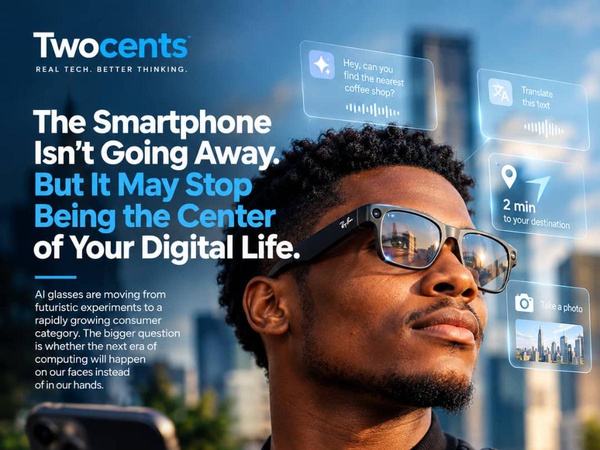
<p><br/></p><p><br/></p><p>AI glasses are moving from futuristic experiments to a rapidly growing consumer category. The bigger question is whether the next era of computing will happen on our faces instead of in our hands.</p><p><br/></p><p>For more than a decade, the smartphone has been the centre of our digital lives.</p><p><br/></p><p>We wake up with it.</p><p><br/></p><p>We communicate through it.</p><p><br/></p><p>We work on it.</p><p><br/></p><p>We shop with it.</p><p><br/></p><p>We navigate with it.</p><p><br/></p><p>We take photographs with it.</p><p><br/></p><p>We use it to access almost everything connected to the internet.</p><p><br/></p><p>That makes the idea of replacing the smartphone sound almost absurd.</p><p><br/></p><p>But technology rarely replaces something by announcing that it has arrived to replace it.</p><p><br/></p><p>Sometimes it simply makes the old device less central.</p><p><br/></p><p>And that may be what is beginning to happen with AI glasses.</p><p><br/></p><p>Something unusual is happening with glasses</p><p><br/></p><p>Smart glasses have existed for years.</p><p><br/></p><p>Most failed to become mainstream.</p><p><br/></p><p>The latest generation is different because companies are no longer trying to put a tiny computer on your face simply for the sake of putting a computer on your face.</p><p><br/></p><p>They are trying to make glasses useful.</p><p><br/></p><p>Call someone without reaching for your phone.</p><p><br/></p><p>Ask a question.</p><p><br/></p><p>Translate what you're looking at.</p><p><br/></p><p>Get information about your surroundings.</p><p><br/></p><p>Listen to music.</p><p><br/></p><p>Take a photograph.</p><p><br/></p><p>Summarise something.</p><p><br/></p><p>Interact with an AI assistant.</p><p><br/></p><p>And increasingly, do these things without stopping what you're doing.</p><p><br/></p><p>Meta's latest announcement is a good example.</p><p><br/></p><p>At its September 23 Connect event, the company introduced new Ray-Ban Meta models, including Ray-Ban Meta Audio, its first audio-only glasses, alongside new AI features and a broader lineup. Meta says it expects more than 100 glasses options across its Ray-Ban, Oakley and Meta Glasses ranges by the end of the year.</p><p><br/></p><p>The important part isn't the number of styles.</p><p><br/></p><p>It's the direction.</p><p><br/></p><p>AI is moving closer to the human body.</p><p><br/></p><p>And people are actually buying them</p><p><br/></p><p>This isn't just a futuristic concept anymore.</p><p><br/></p><p>Omdia estimates that global AI-glasses shipments reached 4.2 million units in the first half of 2026, a 127% increase from the same period a year earlier.</p><p><br/></p><p>Meta accounted for approximately 3.4 million of those shipments, giving it an estimated 81.3% share of the market during the period.</p><p><br/></p><p>IDC's numbers tell a similar story about the wider glasses and XR market.</p><p><br/></p><p>In the second quarter of 2026, audio glasses—devices without displays, such as Ray-Ban Meta—represented 70.3% of XR glasses and headset shipments, up from 61.9% a year earlier. IDC estimated Meta's overall share at 68.7%.</p><p><br/></p><p>The exact market estimates vary between research firms because they define and measure the category differently.</p><p><br/></p><p>But the broader signal is difficult to miss:</p><p><br/></p><p>AI glasses are no longer just a novelty category.</p><p><br/></p><p>Why glasses might work where smartwatches struggled</p><p><br/></p><p>The biggest advantage of glasses is not that they have more computing power than a smartphone.</p><p><br/></p><p>They don't.</p><p><br/></p><p>The advantage is context.</p><p><br/></p><p>Your phone sits in your pocket.</p><p><br/></p><p>Your glasses sit in front of your eyes and beside your ears.</p><p><br/></p><p>That means they can potentially understand more about what is happening around you while keeping your hands free.</p><p><br/></p><p>Imagine walking through a foreign city.</p><p><br/></p><p>Instead of pulling out your phone, opening a translation app, pointing the camera and reading the result, your glasses could interpret what you're seeing and provide the translation through audio.</p><p><br/></p><p>Or imagine attending a meeting.</p><p><br/></p><p>Your glasses could help you remember information, provide contextual assistance or summarise something afterward.</p><p><br/></p><p>Or imagine someone with visual impairment using AI-powered glasses to describe objects, read text or identify elements of their surroundings.</p><p><br/></p><p>The technology becomes interesting not because it replaces the smartphone's capabilities.</p><p><br/></p><p>It becomes interesting because it can deliver some of those capabilities without demanding your attention from the physical world.</p><p><br/></p><p>The screen may be the thing that disappears</p><p><br/></p><p>This is where the current generation of AI glasses gets particularly interesting.</p><p><br/></p><p>For decades, computing has followed a predictable pattern:</p><p><br/></p><p>Desktop.</p><p><br/></p><p>Laptop.</p><p><br/></p><p>Smartphone.</p><p><br/></p><p>Each generation made computing more portable.</p><p><br/></p><p>But all three still require you to look at a screen.</p><p><br/></p><p>AI glasses introduce another possibility:</p><p><br/></p><p>What if you don't always need to look at a screen?</p><p><br/></p><p>Meta's Ray-Ban Meta Audio glasses are designed around audio rather than a visual display. Other companies are experimenting with glasses that add displays, cameras or other sensors.</p><p><br/></p><p>Meta is also developing more advanced glasses that combine AI with displays and gesture controls.</p><p><br/></p><p>The result could be a computing environment where the interface is no longer always a rectangle in your hand.</p><p><br/></p><p>Sometimes it could be your voice.</p><p><br/></p><p>Sometimes your surroundings.</p><p><br/></p><p>Sometimes a small visual layer in front of your eyes.</p><p><br/></p><p>And sometimes no screen at all.</p><p><br/></p><p>But there is a problem we haven't solved</p><p><br/></p><p>The more capable these glasses become, the more they can potentially see and hear.</p><p><br/></p><p>And that creates a problem that smartphones don't quite have at the same scale:</p><p><br/></p><p>Other people are part of the environment too.</p><p><br/></p><p>You may know that you're wearing an AI-enabled camera.</p><p><br/></p><p>The person sitting across from you may not.</p><p><br/></p><p>That's why privacy has become one of the biggest challenges facing the category.</p><p><br/></p><p>Reuters reported this week that AI-powered wearables are facing growing privacy concerns, particularly around cameras and recording. The concerns range from covert recording to how sensitive footage and other personal data might be processed.</p><p><br/></p><p>Several jurisdictions are already scrutinising how smart glasses are used.</p><p><br/></p><p>France, for example, has seen regulatory and legal attention surrounding alleged misuse of camera-equipped smart glasses.</p><p><br/></p><p>This means the success of AI glasses won't depend only on battery life, camera quality or AI performance.</p><p><br/></p><p>It will also depend on whether society becomes comfortable with people wearing computers that can see and hear.</p><p><br/></p><p>The industry knows this</p><p><br/></p><p>Interestingly, privacy isn't being ignored by the companies building these devices.</p><p><br/></p><p>Meta published details about private processing for its AI glasses on September 23, explaining how some functions can happen directly on the glasses while more advanced AI capabilities require larger models elsewhere.</p><p><br/></p><p>That distinction matters.</p><p><br/></p><p>If everything your glasses see and hear has to leave the device and travel to a remote server, the privacy implications become much bigger.</p><p><br/></p><p>Local processing can reduce some of that dependence.</p><p><br/></p><p>But it doesn't automatically solve every privacy problem.</p><p><br/></p><p>A device can process information privately and still be used irresponsibly.</p><p><br/></p><p>The technology therefore needs both technical safeguards and social rules.</p><p><br/></p><p>The smartphone may become the engine room</p><p><br/></p><p>There is another possibility that is more realistic than the idea of a sudden "smartphone killer."</p><p><br/></p><p>Your phone may remain extremely important.</p><p><br/></p><p>It could simply become less visible.</p><p><br/></p><p>Think about what happens when you use wireless earbuds.</p><p><br/></p><p>Your smartphone is still doing much of the heavy lifting.</p><p><br/></p><p>You just aren't interacting with it directly every second.</p><p><br/></p><p>AI glasses could follow the same pattern.</p><p><br/></p><p>The phone becomes the engine room.</p><p><br/></p><p>The glasses become the interface.</p><p><br/></p><p>Your AI assistant becomes the layer connecting everything.</p><p><br/></p><p>Instead of:</p><p><br/></p><p>Person → Smartphone → App</p><p><br/></p><p>the experience starts moving toward:</p><p><br/></p><p>Person → AI → Services</p><p><br/></p><p>The physical device becomes less important than the intelligence connecting the services behind it.</p><p><br/></p><p>That would be a much bigger change than simply selling another type of wearable.</p><p><br/></p><p>The real competition may be for your attention</p><p><br/></p><p>This is why the next phase of personal technology could become fascinating.</p><p><br/></p><p>The smartphone won partly because it put almost everything in one place.</p><p><br/></p><p>But it also created a new problem:</p><p><br/></p><p>We spend enormous amounts of time looking down at screens.</p><p><br/></p><p>AI glasses offer a different proposition:</p><p><br/></p><p>Let the computer come with you without demanding your eyes every time.</p><p><br/></p><p>That could be useful.</p><p><br/></p><p>It could also create a different kind of distraction.</p><p><br/></p><p>If an AI assistant can constantly listen, answer, remind, recommend and notify, the challenge may shift from getting information to deciding when not to receive it.</p><p><br/></p><p>The future of computing therefore isn't automatically going to be better simply because the computer becomes more invisible.</p><p><br/></p><p>Invisible technology can still be intrusive technology.</p><p><br/></p><p>So, is this the end of the smartphone?</p><p><br/></p><p>Probably not in the way people imagine.</p><p><br/></p><p>The smartphone is too deeply integrated into communication, banking, photography, work, entertainment and countless other services.</p><p><br/></p><p>AI glasses have a long way to go before they can replace all of that.</p><p><br/></p><p>But they don't need to replace the smartphone to change computing.</p><p><br/></p><p>They only need to make you reach for it less often.</p><p><br/></p><p>That is a much lower—and potentially much more achievable—bar.</p><p><br/></p><p>The first personal computer made computing accessible.</p><p><br/></p><p>The laptop made it portable.</p><p><br/></p><p>The smartphone made it almost universal.</p><p><br/></p><p>AI glasses could make computing more ambient.</p><p><br/></p><p>Instead of going somewhere to interact with technology, technology increasingly comes with you.</p><p><br/></p><p>And if that happens, the next major computing platform may not be the device sitting in your pocket.</p><p><br/></p><p>It may be the device sitting on your face.</p><p><br/></p><p>The smartphone isn't going away.</p><p><br/></p><p>But for the first time in years, it may no longer be the only device we build our digital lives around.</p>


 5
5


Other insights from Galton








Contributor Points

Points-to-Coupons

Referral Earning

Insights for you.


My Unpopular opinions of Social Media.
I Really Hate Social MediaWait, hear me out.I'm not saying this from a place of pride o...
219 views
33 upvotes
40 comments


Meet Amina the AI
Well yes, the image attached to this post was created with DALLE. After some interestin...
1459 views
19 upvotes
12 comments


If You Can’t Beat Them, Join Them
I didn’t experience the “before.” Before landlines, before phones, before mobile money—...
309 views
27 upvotes
25 comments


Grandpa lied (A little)
"Grandpa said, farming pays and not even your AI can take that away" that was my cousin...
315 views
25 upvotes
26 comments


Social Media vs Reality – Let’s Be Fo...
Let’s talk. Be honest, have you ever looked at someone’s Instagram story and immediatel...
433 views
15 upvotes
15 comments


Are we becoming who we are, or who we...
We are shaped long before we realize itby things we do not question,by voices we do not...
294 views
19 upvotes
20 comments


Over sharing with a bot : it's not th...
Lately I’ve realized my most stable relationship might actually be with ChatGPT. 😭 I co...
458 views
16 upvotes
16 comments


The Impact Of Social Media vs Books: ...
A social media personality emerged on the internet months ago and a basic small toy tha...
361 views
19 upvotes
15 comments


Tech is the New White Collar Job
Tech is the New White Collar Job
Tech is the new currency; with tech, you can say cr...
1055 views
17 upvotes
11 comments

Three (3) reasons why AI is losing to...
This article explains how Google's new policy affects AI-written content and flagging g...
811 views
17 upvotes
17 comments